For Phyl: Space Elevators

>> Thursday, March 18, 2010
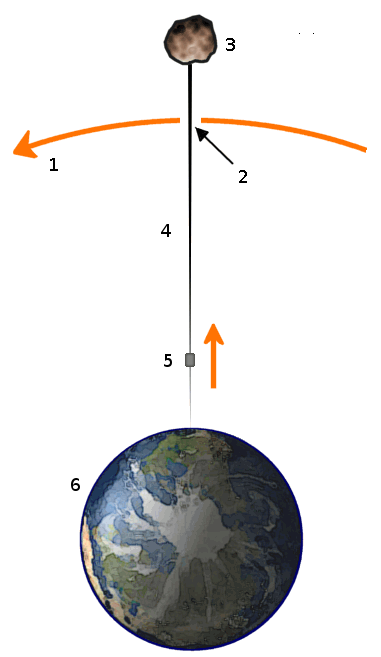

Phyl asked (some time ago - sorry I took so long): What do you think of that "elevator" idea of getting off the earth?

I'm glad you asked. In short, not much. Now, after waiting so long, you deserve a better answer than that, and you'll get it, but I thought I'd cut to the chase.

The idea, for those of you who aren't familiar with it, is that one could construct a cabling system that reach all the way out to geosynchronous orbit, a point that would rotate directly overhead at the equator. You'd need a substantial mass on the other side to balance the total (cable and slide(s)) going down to the surface so that the center of gravity would stay at geosynchronous. z

If you could construct this, the idea goes, you could just ride an elevator up to orbit without requiring rockets and such-like, bringing yourself to orbital velocity and making it far easier to launch stuff out into outer space.

If it worked.

The general thought, for those excited by this notion, is that, if we could just get a material strong to take bear 36,000 km of its own weight but light enough not to make the amount of mass required above geosynchronous less than onerous, this would be workable. Nanotubes look promising, but they're only microscopic so far. Putting them in a resin matrix or whatever drastically reduces their strength. (I could tell you the ridiculously high strength they need but it won't mean much to most of you: 65–130 GPa tensile strength. Kevlar gets up to ~4, most steel is <2 and quartz gets up to 20).

You'll have to pardon me if I seem skeptical. Say you solved all your material problems and ended up with a cable that only weighed, say 500 metric tons. A 13mm kevlar rope 38,000 km long weighs more than 3240 metric tons. That's a bit less than 10X the mass of the ISS sent far far higher, geostationary.

The first question that comes to my mind is, if you need to send three million metric tons into high orbit to get this up and running, what exactly are you saving on rockets later? Once I've fired 10 station's worth of hardware up there, I might as well have just launched from the ground. And, even having all of this in space doesn't change how much energy you need to put into the system. To get into geostationary orbit, even via elevator, requires the same amount of energy to raise the potential and increase the speed.

You can't get something for nothing. You have to put energy into whatever you put into orbit to get it there. A lot of energy. If you use the energy of the elevator to pull it up, you will slow down the elevator and/or lower the orbit.

Truth is, I just don't like it. I don't think we're close to this and, if we can do it, I'm not sure it will buy us as much as we think it will.

Truthfully, if I was going to look for something to help us get into orbit without pure rockets, I'd be looking for an electrodynamic rail system to launch something to several times the speed of sound and then just use a rocket to kick it up the rest of the way. In this way, without rockets, one could take great masses up fairly high (perhaps put the rail up a mountain) and accelerate it at a controlled rate over a long distance. Still uses energy, of course; can't get away from that. You also have a large infrastructure to build, but it's built here on earth where that's relatively easy. And you can use methods we've already used. The US Navy has built a rail gun capable of accelerating a 3.2 kg projectile to Mach 7. It's only a matter of scale to make it do more.

Hope that helps.

Read more...

Answers for Yesterday

>> Wednesday, March 17, 2010

I'm going to write such the good answer for Phyl who has patiently waited, now, about a week. I'll try to get it up by midnight (I did have plenty of time to think about it).

Here are the answers. Clearly my non-SF/F and non-classics are desperately eclectic, too eclectic for most. Oh well, here they are:

  1. These Old Shades, the best of a positive pantheon of excellent Georgette Heyer classics
  2. Artemis Fowl, by Eoin Colfer (I hope I spelled that right). Yeah, I'm charmed by sarcasm.
  3. The Secret Garden by Frances Hodgson Burnett
  4. Shogun by James Clavell
  5. Watership Down by Robert Adams
  6. Hawaii by James Michener
  7. The Bourne Identity by Robert Ludlum I'm not much into mysteries but I do like these. I don't like Clancy, though.
  8. The Red Dragon by Thomas Harris, my favorite of his books, though not the most well known.
  9. Imitation in Death by JD Robb (aka Nora Roberts)
  10. Murder Must Advertise by Dorothy Sayers
Now you know. I'm insane.

By the way, I forgot to mention that the bonus on the first one I did was All Things Bright and Beautiful by James Herriot. Undoubtedly, his books are my favorite non-novels.

Read more...

Carrying on the List From Yesterday

>> Tuesday, March 16, 2010

See, you all probably thought I'd give you all the answers today. Haha, not so fast. I'll be the first to say that I would have struggled to determine some of these books from the first line, but I do know my characters. And, besides, I got the idea from Relax Max. Again. So, for all the ones not guessed, I'm going to provide character names and let you try again. If there was a character mentioned in the first line, I'll assume it wasn't enough and add a second character.

  1. Justin Alastair, Duke of Avon
  2. Holly Short
  3. Mary Lennox and Dicken Sowerby
  4. Shogun by James Clavell
  5. Fiver
  6. Abner Hale
  7. Marie Ste. Jacques
  8. Will Graham and Francis Dolarhyde
  9. Roarke and Niles Renquist
  10. Death Bredon
And yes, though I should be addressing a space elevator, I'll be doing this on Ask Me Anything and Rocket Scientist.

Read more...

Other Favorite First Lines

>> Monday, March 15, 2010

And, yes, for completeness as I redo Relax Max' exercise from his blog (instead of answering Phyl's excellent question which I will get to tomorrow), here are more first lines from favorites that aren't necessarily classics and aren't SF/Fantasy. Wanna guess?

  1. A gentleman was strolling down a side street in Paris, on his way back from the house of one Madame de Verchoureux.
  2. Ho Chi Minh City in the summer.
  3. When Mary Lennox was born, no one really wanted her.
  4. The gale tore at him and he felt its bite deep within and he knew that if they didn't make landfall in three days they would all be dead. [I never before noticed that one of my favorite books of all times starts with a run-on].
  5. The primroses were over.
  6. Millions upon millions of years ago, when the continents were already formed and principal features of the earth had been decided, there existed, then as now, one aspect of the world that dwarfed all others.
  7. The trawler plunged into the angry swells of the dark, furious sea like an awkward animal trying desperately to break out of an impenetrable swamp.
  8. Will Graham sat Crawford down at a picnic table between the house and the ocean and gave him a glass of iced tea.
  9. Summer of 2059 was a mean and murderous bitch who showed no sign of lightening her mood.
  10. "And by the way," said Mr. Hankin, arresting Miss Rossiter as she rose to go, "there is a new copy-writer coming in today."
And here's a bonus, not a novel but a great book anyway...
  • As I crawled into bed and put my arm around Helen it occurred to me, not for the first time, that there are few pleasures in this world to compare with snuggling up to a nice woman when you are half frozen.
I've done "classics" on Rockets and Dragons and science fiction/fantasy on Rocket Scientist.

Read more...

I Will Be Back

>> Thursday, March 11, 2010

Sorry, folks, work overwhelmed me and I've been putting in the hours at home the last two nights. Phyl even left me a great question that will have to wait until Monday because I'm going out of town to dial-in land and I'm not dedicated enough to try to do the blogs from there. So, come Monday, I hope to be back in the swing of things now that my paper is DONE and my work stuff is finally tapering off.

Read more...

For Phyl: Where Would I Send NASA?

>> Tuesday, March 9, 2010


Phyl asked: If you could decide the direction NASA would take for the next two decades (manned space exploration, going to Mars, concentrating on the space station, doing stuff on the Moon, or something completely different) -- what direction do you think would be best?

It's an interesting question.

First, let's assume that I have complete control over NASA (with ~the same budget as has been proposed) - me and me alone. What would I want to do? I'd want to work towards and effective self-sustaining colony on the moon. Why?

Because it's a vital stepping stone on the way way out there. Before I commit any spacecraft to Mars, I'm going to want to know those spacecraft and landers work, they can land and take off again, that the suits will be effective handling rocks and withstanding dust. I'm going to want to know that I can protect my crew from radiation for long periods of time, that I can extract some of what I need from the soil. I'm going to practice growing things and farming and manufacturing, basically being self-sufficient.

On the moon, everything I need to do is applicable to Mars, only the extremes are more extreme, the dust is sharper, the atmosphere is even less atmospheric. Yet, the moon has the invaluable advantage of being close at hand, relatively speaking. We can test all kinds of technologies and capabilities where rescue is days, not weeks, away, and upmass is just horrifically expensive rather than all but impossible. If we can tame the moon, make it a real colony, we'll know we can tame anything.

However, where we go isn't as important as figuring out the best way to get there. We need to decide what we want to do, what we want to accomplish, and then build the tools we need to get there. Optimize instead of make do or force fit.

Note also that this isn't choosing human spaceflight over unmanned. To me, they are a package deal. You need 'em both.

Now, if I was just a ridiculously rich and decided to go commercial, I would do things differently.

But, then, you didn't ask that.

BTW: This looks like a very interesting book for the space nostalgic.

Read more...

For Boris: What Would I Do?

>> Monday, March 8, 2010


Boris asked: If you had to choose your line of work again, would it still be the same, i.e. awesome rocketry with NASA (personal bias showing through)? What would be your second choice?

Good question, Boris. It should be one I can answer in a few short sentences. But I can't.

It's an excellent question because I'm not sure how much I "chose" this one. See, I am a rare beastie, an accidental engineer. I'd never had the slightest interest or inclination to do anything math related. Oh, science and math were fun and I enjoyed it, but only about as much as I enjoyed history and literature. I always intended to be a writer/novelist. The only thing in question was what would I do for a day job while I waited to get my book(s) written and sold. Stephanie likes eating.

I could do math, of course, in fact, it was so easy for me it was boring to me, which is likely one reason I never intended to pursue it. I think I'd always assumed I'd do foreign languages (which I enjoy great deal) or journalism or genetic engineering. I know, weird choices. Except, journalism, in high school, bored me silly. Writing the "truth" didn't hold any interest for me compared to fiction and I wasn't sure how to make money with foreign languages short of teaching. And genetic engineering wasn't offered at any of my immediate college choices.

But I wasn't set or picky. After all, I was going to write. So, since I was bright (and had excellent SAT and ACT scores - types of proficiency exams), I started applying for scholarships, a lot of them, anything. I figured wherever I had scholarships, I'd pursue.

Which is how I ended up with Engineering Physics - because I could get a scholarship from the Engineering department and a scholarship from the physics department. And, once I started in what I soon discovered was the "hardest" major on campus, I was too stubborn to get out. I wasn't going to let it beat me. I found my job with the same sort of muddling. I wanted to live somewhere "warm", didn't particularly want to do defense or quality assurance and definitely not petroleum. That left NASA.

Why did I tell you all that? Because, knowing what I know now and having an opportunity to get any major I wanted and work wherever I wanted, I think I'd do the same thing. I was exposed to all the science and every major type of engineering, and I like what I ended up with better than anything else. It's more real and practical that straight physics, more predictable than biology, smells better than chemistry, yet it's also far more versatile than any straight engineering field. But it also incorporates bits and pieces of all of it.

I used to think I would have been better off working for NASA directly (which I missed because I'd already accepted an offer with a contractor). Now, I'm glad that my background is more diverse (bioengineering, human factors, environmental science, robotics, calibration, safety, EVA, etc. etc.). And I love where I work now, more freedom, more variety.

So, honestly, if I could do it all over again, I probably wouldn't have changed anything. I wonder sometimes about genetic engineering. But I'm not unhappy, even with some of the frustrations I've run into along the way. I believe in what I do and believe I've made a difference.

So, call that I'd choose the same, with genetic engineering as a second choice.

However, I do have some regrets. I wish I'd pursued some singing training. I wish I'd pursued languages more so I was actually fluent. And I wish I'd pursued the writing itself more assiduously.

But, all in all, I'm good.

Read more...

So You Know

>> Sunday, March 7, 2010

I'm only posting here when I have a question to answer.

So, if I go long periods of time without posting here, it's because I'm out of questions.

Just FYI.

Read more...

For Anonymous: What About Mr. Y?

>> Wednesday, March 3, 2010


Anonymous: can u please do a reading on love for me regarding this new person MR.Y in my life? i was hoping for things to be great. :) thanks Miss T

As a point of interest, there is such a thing as too anonymous. The less information I have, the less likely my reading will mean anything. Not exactly sure why.

But, we'll give it a shot.

Past - Cups 5 (inverted) - In the reversed position, this card describes a past filled with romantic reversal and disappointment. Clearly, your love life has not been fulfilling in the past.

Present - King of Coins - Appears to represent Mr. Y. Someone industrious and practical, slow to anger and intelligent, generous and patient. Someone steady and enduring. Not bad characteristics in a potential lover.

Future - VI The Lovers - I don't think I have to explain it.

Truth is, this is a very propitious reading for potential love and quite clear, no fuzz on it. Very promising.

Read more...

For Anonymous:What A Friend Is Not

>> Tuesday, March 2, 2010

funny pictures of cats with captions
see more Lolcats and funny pictures

Anonymous asked: At the completion of your hiatus, can you tell us what a true friend is NOT?

Well, I can tell you what I wouldn't want to be as a friend, what kind of features I don't associate with friendship, but, since I'm not omniscient, I can only give you my opinion. But, I'm usually willing and able to provide an opinion.

To think of what a friend is NOT, in my opinion, one really starts with what a friend is and look for it's opposite. So, here is my take on what a friend is NOT.

Judgmental: A friend should someone who accepts you as you are, rather than as you ought to be. Whether you both are alike as two adjacent peas or polar opposites, a friend should be someone who isn't driven to make you into someone else who knows who you really are and likes who you really are. Otherwise, that person isn't much of a friend.

Dishonest: I'm not talking the occasional fib ("No, no, I was done with that slice of pizza. Really."), but who will tell you the truth when it matters or when asked. Always. Even if it hurts. Whether it's "I would not serve that lemon cake to your mother-in-law. Let's hit the store," "You have a real problem and I'm worried about you," to even, "I wanted to like your novel, and I really tried to. Unfortunately, I couldn't. It sucked." A good friend can give it to you straight without judging, without loving you less. If they have to pussyfoot around you, one of you isn't a good friend.

Impatient: Often a big part of friendship is being there for someone else. Sometimes, even your bestest friend can be wearying or need more than you can readily give. You're entitled to ask for room, or rest or space, but it should be done with compassion before you've reached the end of your rope so it can be done without angst. And, because you are honest with friends and emotionally entangled, that means that you might very well be dealing with angst yourself once in a while. Patience is how you survive it with a friendship intact.

Self-absorbed: A big part of being a friend is listening, sympathizing, understanding how the other person feels. You can't do that if you're focus is all around you. A friend is more than someone who's there for you; it's someone you are there for, too.

Untrustworthy: A good part of friendship is mutual respect. Friends respect each other's boundaries, secrets, personalities and intentions. They give the benefit of the doubt and their worthy of receiving it.

And, just from the way you worded your question, it reminded me of this last one.

Undemanding: One thing people routinely forget. Friends don't owe friends anything. If your friend does something for you, it should have been because they chose to. Ditto for you doing something for your friend. There should be no price tags, no owesies, no obligation. Friendship is a voluntary thing. Anyone who thinks their friend owes them something, well, I think they don't quite get friendship.
funny pictures of cats with captions
see more Lolcats and funny pictures

Read more...
Blog Makeover by LadyJava Creations