For Aron Sora: Mars Experiments

>> Wednesday, July 28, 2010


Aron Sora said: I also have the most insane idea for an experiment at the Mars Desert Research Center. I want to make solar panels (or atleast one cell), from scratch, in a simulated enviroment. I also want to do an experiment where I compare the efficiency of EVAs with and without UVAs. What do you think?

I'm afraid I need more information before I can give you an answer. When someone wants to do an experiment, it's important to understand what he wants to accomplish or what he's trying to prove.

In order to answer your questions, I need to understand what exactly you mean by them. For the first, do you mean making a solar cell using strictly Mars materials in a simulated space colony environment?

On the surface, it seems simple enough, but I can see some things to watch out for. First, there's an important level of uncertainty when it comes to the materials available on Mars. We've done a large number of analyses, both via rover and remotely, but there are limitations to that. No one has ever brought back actual samples from Mars as they have from the Moon so a certain percentage of our estimations of soil components and compositions is educated guesswork. Therefore, providing "Mars-like" soil samples would be, well, speculative. Even if the Martian soil was largely composed of silicates, obtaining high quality silica from that would take as much as energy as a solar cell could generate over several years on Mars.

But say we knew for sure or decided all we really needed was silicon and we were confident it could be obtained without using so much energy that it would be a waste of time (there are new methods for obtaining high quality silicon that might improve that), you're still talking about specialize equipment, a great deal of it, to gather materials, refine it, make it into a usable form and build the solar cells (and I suspect silicon is not the only key ingredient). In order for this to be a viable plan for on Mars, you have to do all this work either using equipment already planned to be used or specially built for the purpose. That's a multi-year endeavor, even to used it on the ground.

I think the idea has merit. I'm not sure, until we get more efficient and/or a better handle on Martial materials, that it's a viable short term experiment unless we have appropriate equipment already in hand.

As for the other question, I'm not sure what a UVA is. I reached acronym saturation some years back and I'm not familiar with that one. If you mean vehicles, one can experiment with it, but I could also just wander through the Apollo Lunar Surface Journals and find ample evidence of the value of surface vehicles, even when they spew dust and need to be repaired with document covers.

EVAs, of course, depend on having a representative suit available and experiments with those suits are severely hampered on the Earth's surface because of the huge difference in gravitational force. Which makes the wealth of data available from the Apollo missions all the more valuable. Having said that, I think experiments are in work now to evaluate different suit concepts and different roving concepts. I like the one they have now that keeps the suit on the outside of a pressurized vehicle that they can don from inside the vehicle. This severely limits the dust that comes inside, a real issue for the Moon and probably Mars as well.

If you didn't mean vehicles and did mean something else, let me know and I'll see what I think.

Read more...

For Aron Sora: Why Human Spaceflight So Expensive?

>> Sunday, July 25, 2010


The capsule from Apollo 13

Aron Sora asked [building off my last post]: True, but why is manned space more expensive. Why isn't most of the cost for manned flight contained in radiation hardening and designing for temp. extremes?

Good question. Some of the expensive for human spaceflight is for radiation hardening and redundancy and reliability and thermal extremes. Everything true for a multi-million dollar space craft or rover is even more true a spacecraft carrying people. People forget when even an expensive satellite or probe fails. People remember when humans die in space. Even if the folks at NASA didn't care about the humanity lost (and they care, desperately, about that), the impact to existing programs is devastating.

But the long pole for unmanned missions (this design and testing) is just the tip of the iceberg for manned space exploration. For unmanned, you can make things as small as you can make them, as light as you can make them to perform whatever functions you need, and need only enough propulsion to get them where they need to go.

Manned spacecraft must do all that plus (a) they need environment, food, water, clothing, controls, displays, computer equipment, communication equipment, protection from thermal extremes, vacuum, radiation and g forces, waste control systems (air and other), backup systems and a minimum volume over and above what their body takes up AND (b) they must not only make it there, they must make it back . . . safely.

Whereas a satellite or unmanned rover can be disabled and use no power until put into use, manned vehicles must have power, thermal rejection and environmental systems at all time. They must have thermal protection for reentry and protection from excessive shock forces for landing. Not only do we need all these systems, we must have constant instrumentation of these systems (frequently more instrumentation just for these systems than an unmanned craft would have altogether), primary and backup voice and data communication, controls, equipment or instruments (or why bother with people), and consumables/waste facilities. None of which is required for an unmanned one-way rover. And all of these systems need to be tested, preferably in a flight environment, certified and demonstrated working together to get confidence they will keep people alive.

Making it back is a huge deal as well, as I described here, here and here. It means effectively twice the propulsion in separate stages and systems (with separate fuel systems and control systems for each). It means many times the complexity as doing anything outside low earth orbit requires multiple vehicles working in concert, with duplication of controls and systems. It's such a huge scary difficult deal, the number of unmanned missions that have returned can be counted on one hand.

And, yes, I still think it's worth it, partially because it is so difficult. In fact, it's because it's so difficult that I think it's worthwhile. If we can do that, we have no limits.

Read more...

For Jeff King: Why are Interplanetary Robots So Expensive?

>> Thursday, July 22, 2010

One of the downsides to having multiple blogs all on the same system is that I sometimes put my post on the wrong blog. This was first put on Rocket Scientist (where The Mother commented: "Two words: R and D." It should have obviously been put here. Sorry about the confusion.


Jeff King asked: The mars rovers look simple to build, so why do they cost so much to build… actually I thought they would look cool and very complex?

That's actually an excellent question. I think a lot of people wonder how space equipment comes to be so very very expensive. And it is. Even simple straightforward equipment is often an order of magnitude more expensive than it would be in a retail outlet.

There are several reasons for this, but those reasons are driven by two other reasons: extreme environment and reliability. The first reason drives design and it's easy to underestimate the impact of environment on hardware.

To rove around on Mars, a vehicle has to be able to withstand dust and unknown terrain.

It must be able to withstand a radiation environment that is far harsher than we have on Earth (thanks to the protection from our magnetic field), which is hell on electronic equipment, computers and data storage. Most electronic hardware made to withstand high radiation environments are created for military and frequently go through extensive testing and/or "rad-hardening" that exposes them to radiation, testing and often redesign so that they can reliably withstand more extreme radiation environments. This not only increases development and testing time, it might increases material costs if different materials are required to reach an effective design. That increases costs enormously, especially given that there are often only a handful of vendors for a part - which means they can charge nearly anything they want for those consumers who must have them.

The electronics and batteries and all other equipment must also be able to withstand temperature extremes, particularly cold which is very hard on many aspects, including lubricants, batteries, electronics. The extreme in cold can affect tolerances for mechanical interfaces. Which means all equipment must be tested in environments colder than most electronics on this planet need to survive for months if not longer. Vacuum (or, rather, the very very low pressure) adversely affect lubricants as well and complicate thermal characteristics as convection effects are limited. That means you might need some form of heating and cooling for electronics that are cold-sensitive or heat-producing.

For reliability, there are design considerations as well. The design has to be restartable and redundant, in case something goes wrong, or the cost of the whole mission (hundreds of millions, mostly on the trip to/from) is lost. Batteries must be lightweight, high density, resilient to radiation and cold, reliable, and long lasting. Solar arrays must also be lightweight, efficient, reliable and able to use the reduced light available on Mars (compared to here).

Because so much hinges on the functionality of these parts, each part must have a "pedigree" - i.e. been obtained through vendors that have certified processes and materials and who ensure that each part is tracked and verified to be clean and functional. And that makes those parts more expensive.

But, what frequently costs so much is verification and analysis. Hardware is tested, exhaustively, through dedicated use (often months) in testing facilities. Often flight-like prototypes are destructively tested to ensure the flight hardware meets requirements. In addition, a great deal of time and manpower is spent performing reliability and safety analyses, fracture control analyses, fault trees and failure mode and effects analysis, safety assessments.

Frequently, complex (and it can look simple without being simple) devices are one-of-a kind and require exhaustive and unique software that must also be exhaustively tested and retested.

No one's going to sue us if a rover fails, but years of design and planning, years of flying through space, and, literally, hundreds of millions of dollars are at stake, not to mention quite a few reputations.

If it's gotta work, you gotta do it right the first time and that costs a lot of money. But it's cheaper than doing it over. Better more money spent on testing than a second flight because the first one failed.

And that's why they cost so much.

And kudos, I think, have to be offered to the teams that built both Opportunity and Spirit for surviving >20X their expected lifetimes. That design overkill meant we got our money's worth.

Read more...

For Anonymous: Passing the Bug

>> Tuesday, July 20, 2010

First an announcement: For the next two months, I'm forgoing tarot questions. Up until recently, I was getting a steady supply of those and, truthfully, they're generally not very interesting for anyone but the questioner. On October 1, I'll open it back up to tarot questions, but I'm going to limit the number to two per month so people can still come here to learn more general stuff.

Funny Pictures of Cats With Captions
see more Lolcats and funny pictures

Anonymous asked: that if someone gets rid of their bug, someone else can still get it of them a couple of days later?


I'm glad you asked because I only have a vague idea of the answer and love to learn new things. So, off to do research.

Wow, cool. OK, here are some of the answers (because this is biology and there are lots of answers).

First off, people don't necessarily get sick as soon as their exposed to a "bug." Many diseases have an incubation period that can range from hours to days to even years (though the latter is very unusual). What that means is that, if you were exposed to a "bug" (or other pathogen), it could very well take days, weeks, even longer before the disease manifested. That makes tracking down where (and when) you actually got it much more complicated. Long incubation periods (and asymptomatic individuals) can spread disease unknowingly as infectious people pass the bug around without realizing they are "sick." One reason why AIDS is so challenging to control is that people can be infected without realizing it for years - in turn passing it around to others through the use of needles and unprotected sex. So, if you get a bug long after the person you think infected you has recovered, it may be because you were infected much earlier than you thought you were.

This can be particularly tricky when someone is healthy but infected with something, particularly something nasty, as Typhoid Mary was. She had every reason to feel she was healthy and unable to communicate a disease, but managed to infect more than 50 people cooking for them, and was infectious even when she died in quarantine. There are other examples of this kind of thing, but she was somewhat celebrated. And that leads me to another possible answer:

It could also be that the source remained infectious after the symptoms receded. Which meant they were carrying the bug, even if they didn't look like it. With so many over the counter and prescription drugs to treat symptoms, someone could be still quite sick without it appearing so. Though, for some reason, that never seems to happen to me. When I'm sick, I'm miserable no matter what drugs I take. Some diseases manifest in visible ways, like herpes, but can be transmissible even when in "remission." So that's two rather readily available answers to your question.

But wait, there's more. Some diseases can survive for long periods of time on surfaces, like smallpox and tuberculosis and staff bacteria. It's a concern for hospitals who need to ensure surfaces (and hands) are cleaned between patients so that diseases aren't spread between people who never even see each other.

And there's more than one way to become sick: contaminated water or food, exposure to a toxin or radiation, bites of animals (rabies) or insects (malaria, Black plague, lyme disease, etc.), exposure to contaminated fluids or surfaces, parasites . . . any of these can look like a disease you got from a friend without actually being one.

Science, what fun!

Read more...

For Shakespeare: How Hot Is the Sun?

>> Sunday, July 18, 2010


Shakespeare asked: How hot is the sun, how did it get this way, and how does it stay hot without burning up?

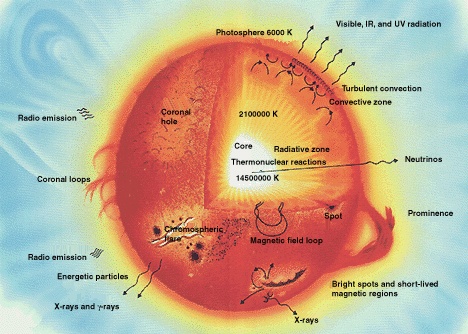
Good questions. First off, whenever I get a question about the solar system, I stop off first at Nineplanets.org. Great educational stuff about about the planets, their moons and, of course, the sun. Wikipedia's a good source, too. The temperature of the Sun is actually a tricky question. Like the gas giants, the sun isn't a solid mass but a tightly packed gaseous mass (though it is very very massive - 99.8% of the solar system mass is contained within it's "boundaries).

At the core, where the heat is generated, the temperature is 15.6 million degrees Kelvin (and about the same Centigrade - when you get that hot the 270 odd degree difference in scale really doesn't matter). I can't think of an analogy to tell you how hot that is, but it's hotter than anything we can make (or at least sustain) here on earth. The core is also under so much pressure (from the gravitational weight of all that mass) that the core of superheated hydrogen gas is actually 150 times denser than water. Think of that, gasses that weigh more than water.


Near the boundary's of the sun, the so called "surface of the sun" the heat and pressure are much less, 5800 degrees Kelvin (which is still unbearably hot) with sunspots that can be 2000 degrees cooler. However, above this level, there is another level, called the corona that extends far out from this solar "surface" and can be hotter than the surface itself, ~1 million degrees K. You can see the corona in this photograph during a solar eclipse.


Solar flares and limbs and also shove out streaks of fire from the surface. Is this a cool picture or what (taken by Hinode's Solar Optical Telescope)?

The way we understand things, the sun was formed when a dense molecular cloud of hydrogen collapsed. The weight of the mass caused tremendous pressure and heat in the core triggering a nuclear reaction. The heat and energy from the nuclear reaction keep the fire going. Now, that may not make much sense, so let me explain, step by step.

If you compress a gas suddenly, you will increase pressure and temperature. Release it, suddenly, the gas will cool and pressure drops. This is adiabatic heating and cooling and it happens from the work done on the gas without any additional heat added from the outside. There was a lot of pressure, a lot of compression and that meant a lot of heat, which is how the reaction was triggered.

Nuclear reactions aren't like burning the way most of us know it. When something is "burned" we are really breaking down the structure of a mass, combining some of it with oxygen (which is required for fire) and sending much of it into the air. The mass of an object if one could capture all the byproducts from combustion, is the same. Matter can't be created or destroyed without nuclear reactions.

For example, if you burn hydrogen gas in an oxygen atmosphere, you'll get water in return. But the hydrogen's still there, as part of the water, H2O. You can extract it back out because it can't be destroyed with simple combustion.

However, with nuclear reactions, elements are changed into other elements, combined or reduced, and the extra mass those elements shed are released as energy, a lot of energy: e=mc^2 which means the mass times the speed of light squared. That's a lot of energy for a little bit of mass. With fission, the extra mass comes from changing a heavy element, like uranium, into something less heavy like Xenon or Barium. However, even more powerful than a nuclear fission reaction is a nuclear fusion reaction, where hydrogen atoms (the smallest, lightest element) combines to form helium atoms (the second smallest lightest element). The extra mass from the two atoms to form the one larger atom is released as heat and radiation. A great deal of both.

That's what heats up the sun.

And, it is burning up its fuel. It just has so much of it that it takes a really really long time. The sun has used up a great deal of its hydrogen and has a great deal of helium from this reaction. In about another five billion years, it will use up all the hydrogen and start causing helium fusion which makes carbon. The sun will expand, out past where our planet is now, until it's used up all the helium, when it will throw off its outside layers and collapse into a little tiny star.

Fortunately, five billion years is quite a bit of time yet, so no nightmares.

Read more...

For Shakespeare: Why Two Arms?

>> Saturday, July 17, 2010


Shakespeare asked: Why do we only have two arms, instead of 3 or 4, since that would make doing things easier?

Why indeed. Well let me preface my "answer" with a few comments. First, I don't know the answer. I can speculate, but I'm not a biologist and, if I were, my answers would likely be educated speculation anyway. Science has a few hard facts associated with it, but the answer to why questions are rarely among them.

Having said that, I'm going to tell you what I think is the answer to "why." Evolution, the development and adaptation of life over long periods of time to make the species we know today, depends on several things: environment that weeds out traits that are not optimal for survival and the originating species itself. Although the environment can force tremendous changes over time, the underlying species often retains key characteristics.

What struck me, when I began thinking of this, is that, though are untold animals that have more than four limbs (tails, I'll get to them in a minute), but I couldn't think of a single one that had a spine. Invertebrates (exoskeletons like bugs/spiders or squishy stuff like jellyfish/octopi) are far less restricted. However, when I think of vertebrates (birds, mammals, fish, reptiles, and amphibians), I realize there's a consistency: two forelimbs, two rear limbs, perhaps a tail.
.

On birds, that becomes wings and feet. On mammals, the four limbs and, perhaps, a tail or the legs are melded together into a tail and the arms are flippers (like dolphins). Limbs for reptiles and amphibians (though sometimes the limbs are more pronounced than others and sometimes they disappear like snakes). Fish with vertebrae fairly consistently have two main side fins and a tail - not a stretch to see a comparison to the two sets of limbs. But, even with the fish, you don't see six or seven arms on a fish with a spine.

So, my answer to why is that whatever first animals started out with spines, the ones that seeded our species and the rest of the vertabrae, apparently had four limbs. Perhaps that (those) vertabraed survived because the set of four limbs is so versatile, adapting admirably to water and air and land, even walking upright. But it could be a fluke, too, the luck of the draw. In Avatar, James Cameron played with a notion that the animals had an extra set of limbs between forelimbs and hind limbs. The flying creatures had two sets of wings instead of one (and still had fore/hind limbs). Only the N'avi didn't.

But, would the extra arms really be that useful? Would they be just like the other arms only below them on the ribs? If so, you couldn't move them like your top arms - there's no place to put a shoulder joint, or, in fact, any stable bone structure (like a collar bone) to tie to. The ribs, the only bones through there, attach to the spine in one place. You'd have to have muscles there, too, where there aren't any now and it wouldn't be able to move like a regular arm, probably only restricted to two directions for the joint (like legs attach to the hips). That means you could move them forward and backward, but probably not up and down. Pretty limited.

Any way, I wouldn't take anything I've said here as gospel (ha ha!), but that's my two cents on why we only have two arms instead of three or four.

Read more...

For Aron: Honoring the Shuttle

>> Friday, July 16, 2010


Aron asked: I have another nooby question, what do you think of the idea I posted on the Space Tweep Blog, should I go after it?

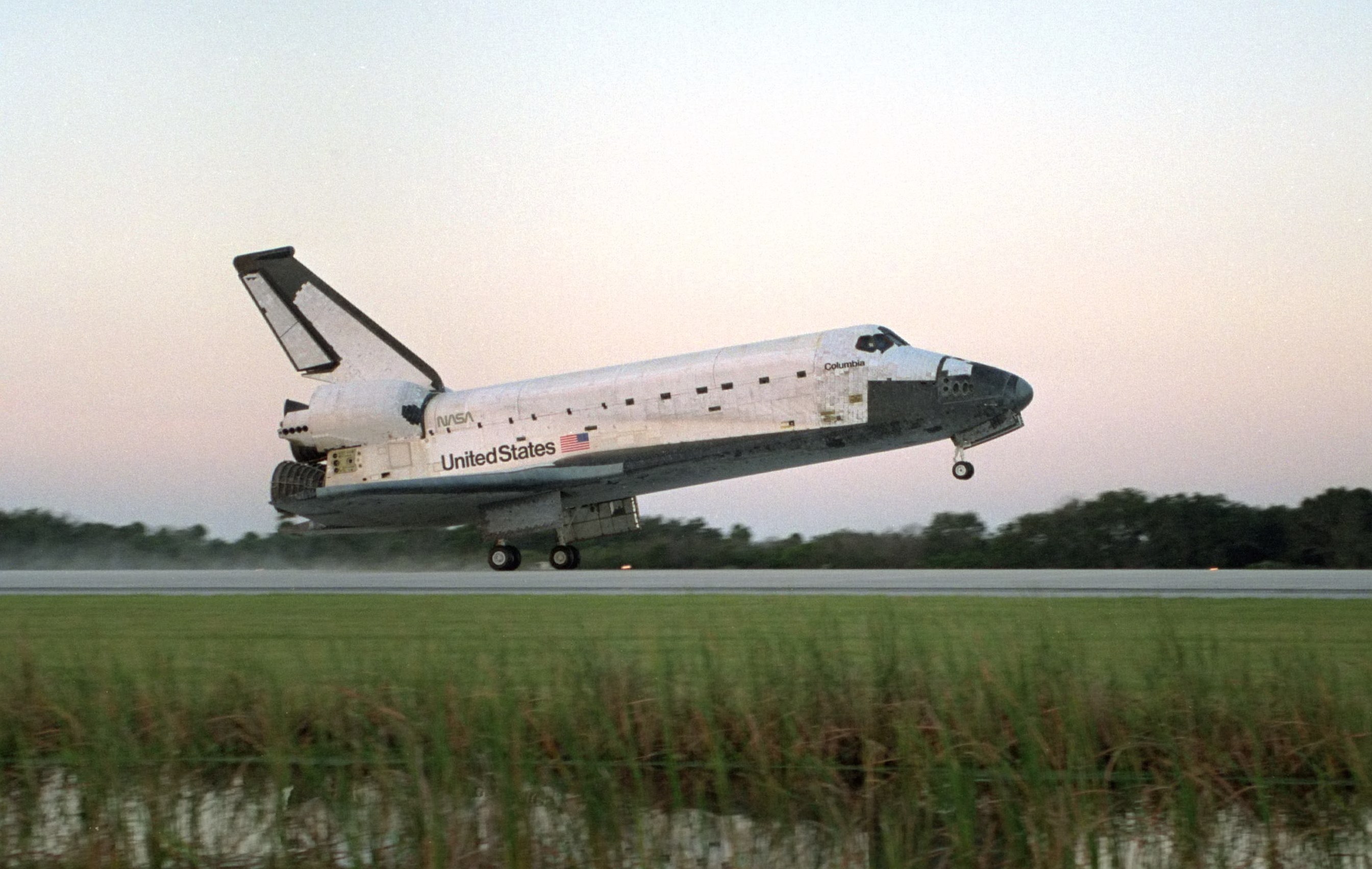
I think it's an excellent idea. For those that never follow links, Aron's proposal was to give homage to the last Shuttle flight (which keeps being put off) by carrying a torch through all of the communities that have supported it, which will cover probably every NASA center (and their surrounding communities) and many military and contractor facilities. The torch (symbolic since I think NASA will still use electronics to ignite the engines and solid rocket boosters) would not only remind us how many people have contributed to the Shuttles in their nearly thirty year lifespan, but also allow people to show that the Shuttle and its contributions have touched them.

The Shuttle is not a perfect beastie (I've talked about her before here and here), but it is still a technological marvel, even today. It cannot take us out of low earth orbit, but it has carried humans into space more than all other US space vehicles combined, more than all of the manned missions that the Soviet Union/Russia have ever launched. We have launched her 132 times, each time manned. 131 times she took her precious cargo to space. 130 times she brought them back safely. Even Soyuz does not have such a record (with regards to human spaceflight). Who knows when we will ever have a vehicle so capable of transporting

She has served this country well, humankind well.

All honor to her and to those who designed, built, service and fly her.

Read more...

For Kristy: Does Arty Like Me?

>> Thursday, July 15, 2010

Well, that is a simple question. I presume you were looking for a tarot reading since I don't know you or Arty. Since it is so simple, I'll try for a single card and see if that gets me there.

XVIII The Star - Hope, rosy prospects, good omen. If Arty liking you is a good thing, then this is a very propitious card.

Good luck.

Read more...

For Relax Max: About My Father

>> Monday, July 12, 2010

Relax Max said: I wish you would write more about your father sometime. What little you have written is very inspiring and interesting.

Technically, he said this on Rocket Scientist, but this is where I answer questions (and the like) so I'm going to use it. I've spoken before on how he was to me as a father. Given the context, I think Relax Max was interested in the work my father did, so that's what I'll talk about.

My father was a slow, plodding learner with a great facility for logical thinking. He wasn't quick with a lightning fast recall. He wasn't witty or particularly imaginative, not prone to flights of fantasy or even rampant speculation. He was deliberate and grounded. When he learned something, it was forever. More importantly, he could take diverse and disparate information and fathom out the meaning, learn from it and take it to the logical conclusion.

He had a master's degree in plant physiology (a souped up botanist) and loved plants and growing things. In many ways, I think he'd have been happiest on a farm or engineering flowers and other plant products in one of the many plant labs in Hawaii. But he got his degree at a time when jobs for botanists were at an ebb. Debilitated by the mold he was studying for his first job (which took root in his lungs), he was laid off just a couple years after graduating and spent three years out of work.

Not entirely out of work. My father's mind was only part of who he was. When it came to work, no one had a stronger or better developed work ethic. Whatever it took, whatever work was available, he did for his young family (four children at that point). He was the eldest of twelve and he knew about responsibility.

Finally, he got a job with EPA (the Environmental Protection Agency). As my father always revered nature, it wasn't a stretch. It was entirely in keeping with his moral sense. And, when it came to ethics, he was unshakable.

He had to take an medical transfer to Las Vegas (where they had a fine lab) because it was move to the desert or his lungs were going to die. But four years in the searing dry heat had done wonders for his health and he craved plants, craved a world of green not brown. So, we moved to Oklahoma in 1984 and he moved from working with plants to becoming a soil specialist, particularly how toxins and contaminants infiltrated soils and aquifers.

Over the next two decades, he waded through every toxic sludge from one end of the country to another, often on the road for months. He helped develop an environmentally friendly vehicle that could wander into the wilder portions of our country without destroying it. Sometimes, he would take the lead on an unpopular environmental issue, promoting change. Sometimes, he thought things were going too far or were politically motivated. But he never decided until he had done the research and knew the facts. Not the prevailing attitudes or the political expedience - what did the data say and what were the repercussions. And he wouldn't budge from from what he felt was right. He was always incorruptible.

It was a job and my father took work seriously. But that's not why he did so much. It was about making the world better, keeping the water clean, keeping food crops from becoming contaminated. Knowing what was out there and figuring out how to clean it up.

He wasn't ambitious and wouldn't pander so, though he made good friends who appreciated his work, there were always those who wanted to make him quiet or step aside. He wouldn't. He never got famous or became "important." But he was respected by all those people he came in contact who cared about making the world better for his dedication and his honesty. I strive to do the same where I am.

Many of the compounds he stumbled across were carcinogenic and, in the end, that's what killed him. Cancer, even though there's no history of cancer anywhere previous in our family, took him out in about a year. A healthy man who walked miles every day, his mind as clear as when he was in his teens, struck down by what he was trying to protect us from.

Am I proud of the work he did? Damn straight.

Do I care about making the world better, speaking out for what I believe is right? Hell yes.

No apologies.

Read more...

For Shweta: Where's My Soulmate?

>> Wednesday, July 7, 2010

Shweta asked: hey stephanie... could u please read the tarot for me and tell me when i am going to meet my soulmate. I just had had a heartbreak...n it still hurts...but its ok..all i want to noe is when i am going to meet the perfect love.. the soulmate i am waititng for.. could plz read the tarot n tell me...

I'm assuming you're also anonymous since you both asked the same thing.

Past - Swords III - Separation, disruption, unrequited love. Sounds like your heartbreak right there.

Present - Coins III - This card is about practicing one's skills and industry, focusing on your profession or trade, practical skills. From this, I'd say the cards are thinking that you might have a bit of time where you'll be focusing on something other than love.

Future - III The Empress - The Empress, however, argues that love and family are in your future. The empress is about womanly power, fertility, family, marriage. Which argues that your soulmate is out there and will find you (or vice versa).

I've never had any luck pinpointing a "when" - I'm hoping and if will suffice.

Read more...

For Aron: What About Space Habitation?

>> Tuesday, July 6, 2010

Aron asked: What do the cards say about space habitation? Will we become spacefaring?

Aron, I have no trouble doing a reading on this, but, before I pull a single card, I have to tell you that I'm absolutely certain that, someday, humans will be spacefarers, will live and walk on planets and ships far from the Earth - as long as we don't destroy ourselves in the meantime. But I don't expect that to happen.

Still, you didn't ask me; you asked the cards. So, let's see what they have to say about space habitation. I'm going to pull three cards to ask if we are on the right path, what we can do to further it and what the final result will be.

Our path - Coins V - This card talks about labor and intelligence to achieve a goal, using hard work and common sense. However, it also speaks of adversity and lack of means, support and help denied. Clearly, the lack of sufficient resources will make the work necessary to achieve our goals just that much harder.

What we can do - I The Magician - Imagination, cunning, creativity, carrying something through to completion - these are all key elements to the Magician, a card of self-mastery, self-confidence and initiative. But there is another element that might be important, here: that touch of inspiration and manipulation that can garner the support, perhaps, we are currently lacking.

Final outcome - XIII Death (reversed) - Clearly, the cards are less optimistic than I am. In the reversed position, this card speaks of stagnation and preoccupation with the past, rather than the forward movement so desperately needed.

Given that rather bleak projection, I'll pull one more card to see if there is any hope for the future of space habitation: III The Empress (reversed) - unfortunately, it is more of the same: indecision, inaction and delays.

The cards don't seem hopeful. Let's see if we can change the path and build a different future.

Read more...
Blog Makeover by LadyJava Creations